Music and Language (I) – Why We Use Music?

We love using music in our Chinese immersion classroom. Therefore, we have written the following two blogs which are about why and how we use music in our classroom.

Music and language interweave with each other and play a profound role in human’s development. For one reason, the music system and the language system share a lot in common. For example, they both have rhythm, tonality, pauses, and stress. For another reason, the combination of the two systems can produce positive effects on both systems. For instance, when we combine music and language to become a song, the language becomes more vivid and easier to express emotions.

For children learning their first language, scientists believe that children’s imitation of the rhythm and musical contours of the language even comes before the speaking of the words. When an infant is listening to a song, he/she does not only learn to discriminate between sounds, but also to acquire the language in a musical context. In other words, music can catalyze children’s language development.

It is not only true for children’s first language acquisition. As we are using music in our Chinese immersion classroom, we notice a lot of advantages in our children’s Chinese acquisition through music, too. In the next blog, we will talk about how we use music creatively in class.

-Chinese with Meggie Language School, Austin, Texas
The Benefits of a Small Class II – How to Make Use of It

As we have talked in last blog, there are several benefits in keeping the class size small in our case. However, as a smaller class size means a greater individuality, simply dividing 10 children into 3 groups does not mean we will achieve all that we expect from a small class size.

Children learn differently. If a large class size minimizes differences, a small class size maximizes them. Therefore, students should be grouped smartly and teacher should make sure they learn.

First, our old and new students are mixed together. Grouping new and old students together helps creates a language environment and it is especially effective in a language classroom. The first benefit is that new students will be motivated and in many cases repeat our old students’ Chinese. Also, our old students can sometimes be little teachers in class. For instance, they can tell a picture book story to new students with the help of the teacher.

Second, to make full use of a small group size, the teacher offer individual time to every student in class. The individual working time is both short and intensive. It can be going through a series of fruit flashcards with students individually, or it can be interact with one student about what interests him/her particularly. The individual working time is short, which lasts about less than one minute in most cases. However, it yields great benefits: First, the particular student gets very intensive language practice catered to his/her learning interests; and second, the other students in class are also listening and learning.

-Chinese with Meggie Language School, Austin, Texas

How We Benefit From a Small Class Size

At the very beginning, it is necessary to point out that even though parents tend to think that students can always be benefited from a small class size, not all studies support such a conclusion. On the other hand, a large class size has some of its own advantages: better preparation for college environment, better social opportunities, and greater efficiency in the use of education resources.

Smaller does not simply equals better, but it IS better only when it matches with certain teaching style and class environment. As reflected in our teaching practice, we find that a small class size works especially well with our teaching method and here is why.

First, in our classroom, students are not fixed on tables or chairs. They are free to move around the rug. However, there should still be an order in the classroom. Too many students will make it hard to achieve the order. Under such a condition, a small class size means that a balance can be achieved between the freeness of students and the teaching authority.

Second, small class size helps teachers design more group-specific activities. Not every student enjoys every single game. A small class size lets teacher cater to every student’s interests as it allows the teacher to avoid games that the specific group of students may not enjoy.

Third, when it comes to language teaching, smaller class size means that children get more opportunities in interacting with the teacher. In order to learn, children need interactive language situations and conversations that are pitched to their level. For instance, when reading a picture book with a group of four children, the teacher can interact with every child when reading verbally or physically; while with a group of ten, interacting with every student while reading only makes the reading procedure long and tiresome for students.

-Chinese with Meggie Language School, Austin, Texas

How to Help My Child If I Do Not Know Chinese? (III) – Flashcard

Children from our elementary program get Chinese flashcards every week. They review the cards with their parents to reinforce what they have learned at school. How to go through Chinese flashcards with children at home? Is there anything that parents should always bear in mind?

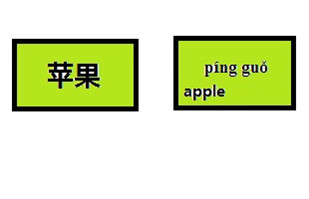
First, change the method of going through flashcards with your child from time to time. For example, for the flashcard “苹果 (apple),” you can show your child the Chinese characters and let him/her read out, or you can mix all the flashcard together and let him/her find the “apple” for your, or you can read the Pinyin for “apple” and ask him/her to find the card. By making this a game, you will find that children are not easy to get bored even if they are practicing the same vocabulary.

Second, make the practice short but frequent. For example, you can spend three minutes going through the flashcards with your child before snack time, another three minutes before he/she takes the bath, and another three minutes after he/she wakes up from the nap. Also, always give him/her something new. For example, if we have ten flashcards in total, review five of them with your children on the first day, and replace one of them with a new one the second day. By doing this, little by little, your child will amaze you how much he/she progresses.

Third, always stop before your child gets bored. You should be aware when he/she wants to stop, and stop before that. Therefore, they will look forward to next time’s practice. This “Stop Beforehand” principle does not only apply to flashcard learning, but it is true for all human beings at all stages of development.

All the points above are simple and you may find them easy to be applied into your flashcard review at home. You can really help your child embark on a new journey through language!

Also refer to our previous blogs:

How to Help My Child If I Do Not Know Chinese (I)

How to Help My Child If I Do Not Know Chinese (II)


-Chinese with Meggie Language School, Austin, Texas

Activity Snapshot (I) – Crossing the Tunnel

To provide you with a more straightforward impression of language immersion, this blog series is about how different activities work in an immersion class. Here is a snapshot of one of our classroom activities, which aims at teaching children animal vocabularies and also the sentence “这是什么?” (What is this?)

We use a play tunnel and a number of toy animals. The teacher sits at one side of the tunnel with all the animals by her side and children surrounding her. She picks up one animal and says the animal name in Chinese clearly, for example “兔子(rabbit).” Then one child gets the “兔子” and crawls through the tunnel with the “兔子” in his/her hand – Children always get really excited about this task. When he/she is crossing, the teacher hands another animal to the next child. After crawling out of the tunnel, the child goes back to the teacher and gives “兔子” back to her. The child then gets another animal and the word’s pronunciation, for example“老虎(tiger).” The child crawls across the tunnel again with “老虎.”

After several times of repetitions, the teacher tries to let children produce the words. She picks up an animal, and asks the student “这是什么?(What is this?)” If the child figures out the meaning of this question sentence, and says the name of the animal. He takes the animal and crawls across the tunnel again. However, if the student does not get the meaning of “这是什么?” the teacher will answer by herself, “兔子。” She makes the answer as simple as possible not to confuse the student. Children can always recognize the meaning of “这是什么?” the second time and try to conduct the animal’s name. After several rounds of repetitions, children know the animal vocabulary, and the sentence “这是什么?”

The remaining work of the teacher is to repeat the same information in other activities again and again to reinforce the memory. This activity is used as a basic vocabulary introduction, which works for all categories of nouns.

-Chinese with Meggie Language School, Austin, Texas

Does Learning More Than One Language Make a Late-Talker?

It seems to be a common belief that a baby begins talking later if he/she is learning a second language, and even later with a third one. King and Mackey have been talking about this popular misconception in their book “The Bilingual Edge” and found a reason for this prevalent myth: there is a great deal of variation in when children begin to speak. One child may utter the first word as early as eight months or as late as sixteen months. In other words, in any given group, children vary greatly in when to begin talking. However, if a bilingual child has a late start, the fact that the child is exposed to two languages is mostly blamed for his/her late first word.

So does learning more than one language make a late talker? In order to answer the question, in 1992, three scholars from University of Miami carried out a research which compared the lexical development of bilingual children and monolingual children (Pearson, Fernandez, Oller, 1993.) In this later widely-quoted study, they compared between 25 English-Spanish bilingual children and 35 English monolingual children ranging from 8-month to 30-month in age. The parents of the children were asked to complete questionnaires concerning the vocabulary their children could say. The result showed that bilingual children develop the same capacity in vocabulary development in both languages and they were almost in the same pace with monolingual children’s vocabulary development. In other words, there were no significant differences between bilingual children and monolingual children in their paces of accumulating new words.

Therefore, it is natural that children differ in their pace of language development. Being exposed to a second language does not impede children’s development in their first one. If language delay really occurs to a child, blaming bilingualism for language delay can block parents from seeing a variety of other reasons which may be responsible for the problem.

Note:
Pearson, B., Fernandez, S., Oller, D., 1993. Lexical Development in Bilingual Infants and Toddlers : Comparison to Monolingual Norms. http://scholarworks.umass.edu/cgi/viewcontent.cgi?article=1006&context=adjunct_sw

King, K., Mackey, A., 2007. The Bilingual Edge. Harper Collins: New York


-Chinese with Meggie Language School, Austin, Texas

How to Help My Child if I do not Speak Chinese? (II)

Besides our general suggestions from last blog, parents can learn Chinese in a way purposefully to help their children. When parents find a way to interact with their children in the target language, children learn it better than merely working alone. Even though it is hard for an adult to pick up Chinese, we suggest that parents can begin from Chinese Pinyin.

Pinyin is used to transcribe Chinese characters to Roman alphabets. And it is easy for English-speakers to recognize and master the Pinyin system. It is a little bit like Spanish – when you know how to pronounce every alphabet, you can read the article without understanding it. Here is how the word “mom” appears in Chinese and Pinyin system:
English: mom
Chinese character: 妈
Pinyin: mā

Every Chinese character can be transcribed to Pinyin in such a way. And for every Pinyin, the item can be divided into “initial” and “final.” As in the example of “mā”, “m” is its “initial,” while “a” is its “final,” and the little hyphen on “a” indicates the character’s tone. There are 21 “initials” and 35 “finals” in Chinese Pinyin, and every Chinese character is made with one “initial” and one “final,” plus a tone. Here is a website with the complete Pinyin chart, and also their pronunciations: http://www.quickmandarin.com/chinesepinyintable/

Therefore, a sentence such as “What is this” can be transcribed into:
English: What is this?
Chinese character: 这是什么?
Pinyin: zhè shì shén me?

Therefore, once parents can read Pinyin, they can read together or interact with children when Pinyin appears in picture books, homework or flashcards (A lot of them have.)

-Chinese with Meggie Language School, Austin, Texas

How to Help My Child If I do not Speak Chinese? (I)

Chinese immersion programs are designed for students and parents who do not speak or speak little Chinese. Even if parents have limited knowledge in the language, they can still affect children positively in learning. We will have two blogs on this topic providing general suggestions, and also specific suggestions particularly for Chinese learners’ parents.

First, parents should be very serious about class attendance. Language learning requires consistency. Too many absences may impede children’s confidence and motivation when they find it difficult to keep up with other classmates due to missing classes.

Second, parents should always encourage your children to come to the teacher when they have questions. In our reading program, our children make one Chinese picture book of their own every week after class, which requires parents’ involvement. Parents can sense their children’s progress when working with children.

Also, parents can expose their children to different things related to Chinese language and culture, such as participating in cultural events, taking them to Chinese restaurant, or playing Chinese songs at home. They should also be encouraged to read Chinese for pleasure at home.

Our next blog will tell parents more about learning Chinese purposefully to work with children.

When Team Teaching Meets Language Classroom…

Early childhood educators tell us that children’s ears are highly sensitive in distinguishing sounds. And from our own experiences, language learning is not right if the learner can only understand his/her teacher’s talking. That’s how “team teaching” came to our mind. In team teaching, a group of instructors cooperate with each other in achieving the learning goal of students. The first hour of the class can be taught by one teacher, while the second hour will be taught by another. While teachers make sure the 2-hour class design is still a coherent whole, this teaching type involves variability.

Chinese with Meggie teachers have been trying this teaching model a little bit with our students, but we plan to make it systemized from the coming fall semester. Here is how we think about it.

Most apparently, team teaching means that children will have the opportunities to meet and work with different teachers. In general, it expands children’s life experience. Specifically in the field of language learning, it exposes students to different ways of speaking and communication in target language. Even though we set up general standards in what Chinese words/phrases/sentences we use with our students in classroom, each individual still talk differently by nature. To take the English acquisition as an example, when learning English, children hear the language with huge amount of variability influenced by gender, dialect, age and emotional state. But our children learn to adjust to the variability in English.

Therefore, in our Chinese class, with team teaching, such differences in English are made possible for our little Chinese learners. We make sure that our students can understand Chinese, but not “my beloved Chinese teacher’s Chinese.”

-Chinese with Meggie Language School, Austin, Texas

Snack Time Helps Children Learn the Language

For every two-hour class, we have a 15-minute snack time. However, it’s not simply about having some food or drinking a cup of juice. Instead, it is an essential learning experience for everyone. It’s natural, productive and fun.

The following is a snapshot of what usually happens during the snack time. Three or four kids sit around a small table, and the teacher asks one of the kids to “拿盘子。 (Bring the plates.)” Then the teacher points to the snack bags “谁的包? (Whose snack bag is that?)” Children always answer:”我的包/某某的包。 (My bag. / Someone else’s bag.)” When the teacher distributes snacks, she asks questions such as: “吃饼干。谁的饼干? (Eat biscuits. Whose biscuit is this?)” “吃葡萄。一个,两个,三个,四个。 (Have some grapes. One, two, three, four.)” This is what we call as “situation-based learning.” Since the interactions are based on real situation, children grasp the meaning of sentences and words naturally without explanation in English. With consistent repetitions by the teacher, our children will finally be able to produce all these words and sentences by themselves.

They may notice that they are learning, or they may not, but at Chinese with Meggie, we strive to make every minute of our class time a wonderful and enjoyable language learning experience.

-Chinese with Meggie Language School, Austin, Texas