How to Help My Child If I Do Not Know Chinese? (III) – Flashcard

Children from our elementary program get Chinese flashcards every week. They review the cards with their parents to reinforce what they have learned at school. How to go through Chinese flashcards with children at home? Is there anything that parents should always bear in mind?

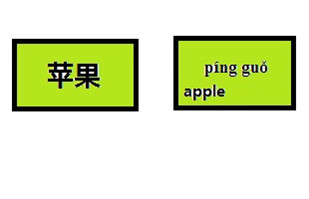
First, change the method of going through flashcards with your child from time to time. For example, for the flashcard “苹果 (apple),” you can show your child the Chinese characters and let him/her read out, or you can mix all the flashcard together and let him/her find the “apple” for your, or you can read the Pinyin for “apple” and ask him/her to find the card. By making this a game, you will find that children are not easy to get bored even if they are practicing the same vocabulary.

Second, make the practice short but frequent. For example, you can spend three minutes going through the flashcards with your child before snack time, another three minutes before he/she takes the bath, and another three minutes after he/she wakes up from the nap. Also, always give him/her something new. For example, if we have ten flashcards in total, review five of them with your children on the first day, and replace one of them with a new one the second day. By doing this, little by little, your child will amaze you how much he/she progresses.

Third, always stop before your child gets bored. You should be aware when he/she wants to stop, and stop before that. Therefore, they will look forward to next time’s practice. This “Stop Beforehand” principle does not only apply to flashcard learning, but it is true for all human beings at all stages of development.

All the points above are simple and you may find them easy to be applied into your flashcard review at home. You can really help your child embark on a new journey through language!

Also refer to our previous blogs:

How to Help My Child If I Do Not Know Chinese (I)

How to Help My Child If I Do Not Know Chinese (II)


-Chinese with Meggie Language School, Austin, Texas

Activity Snapshot (I) – Crossing the Tunnel

To provide you with a more straightforward impression of language immersion, this blog series is about how different activities work in an immersion class. Here is a snapshot of one of our classroom activities, which aims at teaching children animal vocabularies and also the sentence “这是什么?” (What is this?)

We use a play tunnel and a number of toy animals. The teacher sits at one side of the tunnel with all the animals by her side and children surrounding her. She picks up one animal and says the animal name in Chinese clearly, for example “兔子(rabbit).” Then one child gets the “兔子” and crawls through the tunnel with the “兔子” in his/her hand – Children always get really excited about this task. When he/she is crossing, the teacher hands another animal to the next child. After crawling out of the tunnel, the child goes back to the teacher and gives “兔子” back to her. The child then gets another animal and the word’s pronunciation, for example“老虎(tiger).” The child crawls across the tunnel again with “老虎.”

After several times of repetitions, the teacher tries to let children produce the words. She picks up an animal, and asks the student “这是什么?(What is this?)” If the child figures out the meaning of this question sentence, and says the name of the animal. He takes the animal and crawls across the tunnel again. However, if the student does not get the meaning of “这是什么?” the teacher will answer by herself, “兔子。” She makes the answer as simple as possible not to confuse the student. Children can always recognize the meaning of “这是什么?” the second time and try to conduct the animal’s name. After several rounds of repetitions, children know the animal vocabulary, and the sentence “这是什么?”

The remaining work of the teacher is to repeat the same information in other activities again and again to reinforce the memory. This activity is used as a basic vocabulary introduction, which works for all categories of nouns.

-Chinese with Meggie Language School, Austin, Texas

Does Learning More Than One Language Make a Late-Talker?

It seems to be a common belief that a baby begins talking later if he/she is learning a second language, and even later with a third one. King and Mackey have been talking about this popular misconception in their book “The Bilingual Edge” and found a reason for this prevalent myth: there is a great deal of variation in when children begin to speak. One child may utter the first word as early as eight months or as late as sixteen months. In other words, in any given group, children vary greatly in when to begin talking. However, if a bilingual child has a late start, the fact that the child is exposed to two languages is mostly blamed for his/her late first word.

So does learning more than one language make a late talker? In order to answer the question, in 1992, three scholars from University of Miami carried out a research which compared the lexical development of bilingual children and monolingual children (Pearson, Fernandez, Oller, 1993.) In this later widely-quoted study, they compared between 25 English-Spanish bilingual children and 35 English monolingual children ranging from 8-month to 30-month in age. The parents of the children were asked to complete questionnaires concerning the vocabulary their children could say. The result showed that bilingual children develop the same capacity in vocabulary development in both languages and they were almost in the same pace with monolingual children’s vocabulary development. In other words, there were no significant differences between bilingual children and monolingual children in their paces of accumulating new words.

Therefore, it is natural that children differ in their pace of language development. Being exposed to a second language does not impede children’s development in their first one. If language delay really occurs to a child, blaming bilingualism for language delay can block parents from seeing a variety of other reasons which may be responsible for the problem.

Note:
Pearson, B., Fernandez, S., Oller, D., 1993. Lexical Development in Bilingual Infants and Toddlers : Comparison to Monolingual Norms. http://scholarworks.umass.edu/cgi/viewcontent.cgi?article=1006&context=adjunct_sw

King, K., Mackey, A., 2007. The Bilingual Edge. Harper Collins: New York


-Chinese with Meggie Language School, Austin, Texas

The Magic of Picture Books in a Chinese Immersion Class (II) Why Revisit One Single Picture Book?

“Can we do it again?” As Miss Jialu turned the picture book 《小熊哭了》(Little Bear Cried) to the last page, Piya – a four-year-old girl who has been in our immersion class for 5 months asked. As a matter of fact, this is not the first time for this group of children being exposed to the story. Children usually do not get bored with repetitive read-alouds of the same book. That is because every time they approach it, their relationship with the book is one step forward.

Rebekah, a researcher in the field of children’s literacy development found that when children approached picture books in a new language, they first relied heavily on pantomime, excited vocalization and sound effects to get meanings (Rebekah, 2008). Step by step, they transited from merely trying to understand the book to interact with the book. They may interact with the book through physical movements (e.g. Children may mimic what is happening in the book.), or make comments on the book (e.g. Children may tell their peers about their thoughts during read aloud). Every revisit of the book constitutes such a development procedure. As teachers, we ensure that children get enough opportunities to approach the same book through different ways.

As for Piya, when she asked for repeating the book, Miss Meggie simply said: “Piya来讲好不好?(Piya, can you tell us the story?)” As a result, with the help from teachers, Piya got the book, and told the story to her peers in Chinese.

Note:
Rebekah, F (1998). Let’s Do It Again, Language Arts, Vol. 75, No. 3

-Chinese with Meggie Language School, Austin, Texas

When Team Teaching Meets Language Classroom…

Early childhood educators tell us that children’s ears are highly sensitive in distinguishing sounds. And from our own experiences, language learning is not right if the learner can only understand his/her teacher’s talking. That’s how “team teaching” came to our mind. In team teaching, a group of instructors cooperate with each other in achieving the learning goal of students. The first hour of the class can be taught by one teacher, while the second hour will be taught by another. While teachers make sure the 2-hour class design is still a coherent whole, this teaching type involves variability.

Chinese with Meggie teachers have been trying this teaching model a little bit with our students, but we plan to make it systemized from the coming fall semester. Here is how we think about it.

Most apparently, team teaching means that children will have the opportunities to meet and work with different teachers. In general, it expands children’s life experience. Specifically in the field of language learning, it exposes students to different ways of speaking and communication in target language. Even though we set up general standards in what Chinese words/phrases/sentences we use with our students in classroom, each individual still talk differently by nature. To take the English acquisition as an example, when learning English, children hear the language with huge amount of variability influenced by gender, dialect, age and emotional state. But our children learn to adjust to the variability in English.

Therefore, in our Chinese class, with team teaching, such differences in English are made possible for our little Chinese learners. We make sure that our students can understand Chinese, but not “my beloved Chinese teacher’s Chinese.”

-Chinese with Meggie Language School, Austin, Texas

The Magic of Picture Books in a Chinese Immersion Class (I)

The picture book has been widely adapted in the pre-school classroom or as a good resource for story time. However, as a form of visual literacy, it is also a great resource of language development and literature exposure in language classroom. Here is how picture books create a magic with our kids in Chinese immersion program.

We do not use a picture book just because it is in Chinese. Every time before buying a picture book, our teachers decide if it is suitable for language teaching. An ideal picture book is one with repetitions in sentence patterns, and with pictures illustrating the story clearly.

For example, one picture book we are using with our kids is called, “妈妈的帽子不见了。” (Mom’s Hat Is Missing.) The whole book follows the sentence pattern of, “XX的XX不见了。” (XX’s XX is missing.) When read in Chinese, this sentence has a lively rhythm. And the illustrations in the book explain the story in a straightforward way. English is not necessary in class. Finally, every kid in our classes can recite the whole book happily just as a nursery rhyme. When they also had some gestures to go with the book, it has been so much fun for them.

-Chinese with Meggie Language School, Austin, Texas

Snack Time Helps Children Learn the Language

For every two-hour class, we have a 15-minute snack time. However, it’s not simply about having some food or drinking a cup of juice. Instead, it is an essential learning experience for everyone. It’s natural, productive and fun.

The following is a snapshot of what usually happens during the snack time. Three or four kids sit around a small table, and the teacher asks one of the kids to “拿盘子。 (Bring the plates.)” Then the teacher points to the snack bags “谁的包? (Whose snack bag is that?)” Children always answer:”我的包/某某的包。 (My bag. / Someone else’s bag.)” When the teacher distributes snacks, she asks questions such as: “吃饼干。谁的饼干? (Eat biscuits. Whose biscuit is this?)” “吃葡萄。一个,两个,三个,四个。 (Have some grapes. One, two, three, four.)” This is what we call as “situation-based learning.” Since the interactions are based on real situation, children grasp the meaning of sentences and words naturally without explanation in English. With consistent repetitions by the teacher, our children will finally be able to produce all these words and sentences by themselves.

They may notice that they are learning, or they may not, but at Chinese with Meggie, we strive to make every minute of our class time a wonderful and enjoyable language learning experience.

-Chinese with Meggie Language School, Austin, Texas